Last month, Faith in the Valley organizer Roman Rain Tree stood in front of a…
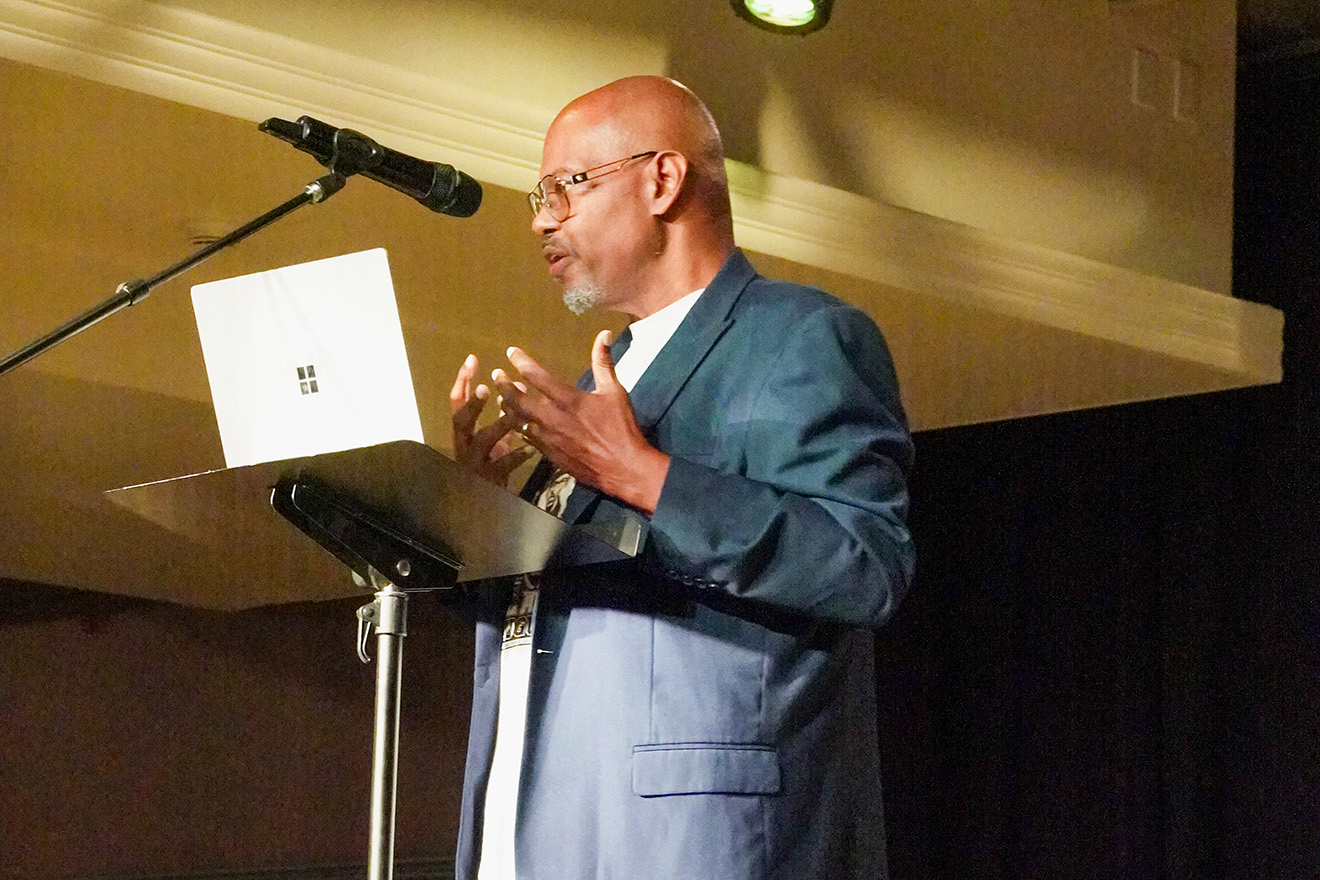
‘Pull Up Another Stool’: Pastor Curtis’s Message for Black August
It’s August 13, and the basement of Woolworth’s in Bakersfield is packed.
Pastor Curtis Smith, our executive director, rests his hand on a plain countertop and asks everyone to close their eyes for a second. Picture it, he says: Four young men sitting down at a Woolworth’s lunch counter in Greensboro, North Carolina, in 1960.
Woolworth’s luncheonettes had long served as gathering places across the country. But in 1960, a Woolworth’s in Greensboro became the setting for one of the defining moments of the Civil Rights Movement. Four Black college students sat down at the lunch counter and asked to be served.
They were refused. They didn’t move. They just stayed.
That image was the whole point of the night. Black August is a tradition of using history to look honestly at the present, and our partners at Community Interventions brought Pastor Curtis in to do exactly that for the Bakersfield community.
It wasn’t just about giving a history lesson, though. Pastor Curtis gave a challenge to everyone in that room to find their own lunch counter, right now.
And Pastor Curtis wasn’t about to let anyone off the hook by keeping the story somewhere far away. He turned the historical lunch counter moment into Bakersfield’s own streets and campuses, starting with the paper trail segregation left behind there.
Researchers at Cal State Bakersfield, he noted, have found roughly 218 housing tracts across the city with racially restrictive covenants dating back to the 1930s and 1940s. People who lived through that time had their own name for Union Avenue: “Separation Street.”
But Pastor Curtis was just as clear about something else: Black history in Kern County isn’t only about what was done to African Americans. It’s what was built by the people who established roots in that community and refused to be ignored.
In 1968, for example, Bakersfield College had more than 200 faculty members and exactly one who was Black. Students organized anyway, and they won. Black faculty. Black counselors. Black history courses. Books that finally reflected them back to themselves.
Then Pastor Curtis turned the question toward what’s happening right now in the Central Valley and throughout the country.
He named the fear immigration enforcement has brought to farmworker families across Kern County, and the way incarceration keeps punishing people long after a sentence ends.
Solidarity doesn’t mean sameness, he said. It means recognition.
“I do not have to become you to know that your dignity matters,” Pastor Curtis said.
The same principle is moving through Sacramento right now in AB 2599, the Truth in Disclosure Act, which would require large corporations to disclose their historical ties to slavery. In other words, truth has to be told before it can be healed.
Then Pastor Curtis asked the crowd to think back to Greensboro one more time.
“Pull up another stool,” he said, putting his own spin on the original story. Those four students in Greensboro were fighting just to claim one seat, Pastor Curtis said. But these times are asking for something bigger, he continued: not just taking a seat for yourself, but making room for somebody else.
When Pastor Curtis said those words, a few people echoed them back.
He said it again, louder.
“Pull up another stool,” he said.
More people joined.
By the third time, the whole room was on their feet, chanting it together, the words bouncing off the walls until it wasn’t a call-and-response anymore. It was a promise.
“Freedom is not merely having a seat,” Pastor Curtis said. “Freedom is having the courage to make room for somebody else.”
That’s the invitation Black August leaves us with—not just to remember, but to act.
So here’s the question Pastor Curtis left in that room, and the one we’re asking you now: Who are you willing to make room for?
Start where you are. Show up to a Faith in the Valley action, bring a neighbor into the conversation, or share this story with someone who needs to hear it.
The stool’s already been made available for you. All that’s left is deciding to sit down.

Related Posts